


Passionate about raising awareness of global environmental challenges and conservation efforts, modern-day explorer and writer Levison Wood has spent the last 15 years journeying through over 100 countries. Now he has released his twelfth book, The Great Tree Story, a deep-dive into the incredible life of forests and how preserving these vital ecosystems is the key to our future.
When it comes to expeditions, Levison Wood has one rule of thumb: if something doesn’t fit into a rucksack, he’s not taking it. “Carrying a few belongings, on your back, makes you live off the land and it’s a great way of meeting people: the amount of hospitality you get when you’re walking is amazing. You’re exposing yourself as being vulnerable and people recognise that,” explains the British explorer, who has spent the last decade undertaking extraordinary journeys around the world on foot. “Walking removes the possibility of escape from situations, which sounds like you’re adding danger, but I think what it does is force you to live life at the slowest pace, as our ancestors did.”
A major in the British Army who served in the Parachute Regiment for 13 years, Levison first appeared on television screens over a decade ago when he walked the length of the River Nile – 4,250 miles that took him nine months. “The first place I went travelling when I was an 18-year-old backpacker was South Africa, and I've been going back to Africa in different capacities ever since. The Nile was this enigmatic river that had fascinated me,” he recalls. “It was also the biggest adventure I could possibly think of, and, when I was doing research, I couldn’t find anyone else who had walked its entire length. I thought, well, that sounds like a challenge.”
Since then, his adventures (many of which have become documentary series and best- selling books) have included spending six months hiking the length of the Himalayas, covering over 1,700 miles from Afghanistan to Bhutan; traversing the length of Central America from Mexico to Colombia (including the notoriously lawless Darien Gap); and circumnavigating the Arabian Peninsula from Iraq to Lebanon. “Writing books, photography and film-making has enabled me to share these experiences with a global audience,” he says, pinpointing his wanderlust back to a childhood interest in the stories of Victorian explorers such as David Livingstone and Richard Burton. “My father was an amateur historian and I remember him reading Homer’s Odyssey to me when I was about 10 years old. It just got me, and I always wanted to go off on a quest when I grew up.”

Connecting with people and shining the spotlight on ecological concerns have always been intertwined for Levison – whether he’s following migrating elephants in Botswana and learning about conservation in the region or witnessing the effects of deforestation on communities and cultures in the Amazon. In fact, it was an encounter with Benki Piyãko, a spiritual leader of the indigenous Ashaninka people of Apiwtxa, who has inspired tribes to unite against corporate greed (at the time of their first meeting, local villagers had planted over two million trees), that sowed the seed for his latest book, The Great Tree Story.
To coincide with its launch, Cape’s Alexandre and Tess recently sat down with Levison to discuss his passion for the environment (a Cape Conversation will be released soon). “It was clear to me that the world is at a critical juncture where habitats are under threat. The global conversation is shifting towards how we can be more sustainable so I thought it was my duty to use my platform to talk about our symbiotic relationship with nature through the ages and how important it is,” he reveals, of his reason behind writing The Great Tree Story. “I've spent three years doing a deep dive into the role that trees play in the world, not just in their capacity to suck up CO2, but their role in society.” He also cites the mind-boggling statistic that despite indigenous peoples only making up five percent of the population, they collectively safeguard 80 percent of the earth’s remaining biodiversity.
To demonstrate how integral trees are, the book delves into everything from religion and science (more and more research shows that trees communicate with each other) to the impacts of agriculture, colonisation and the Industrial Revolution on forest ecosystems. “If you go back to early religions, animism, and paganism, there is a huge respect for nature. Every society from ancient Greece to Rome had a reverence for trees,” says Levison. “I was in South America recently, where the 17th century cathedrals were built by the Spanish and the Portuguese, and their decoration is all vines and branches and flowers.”
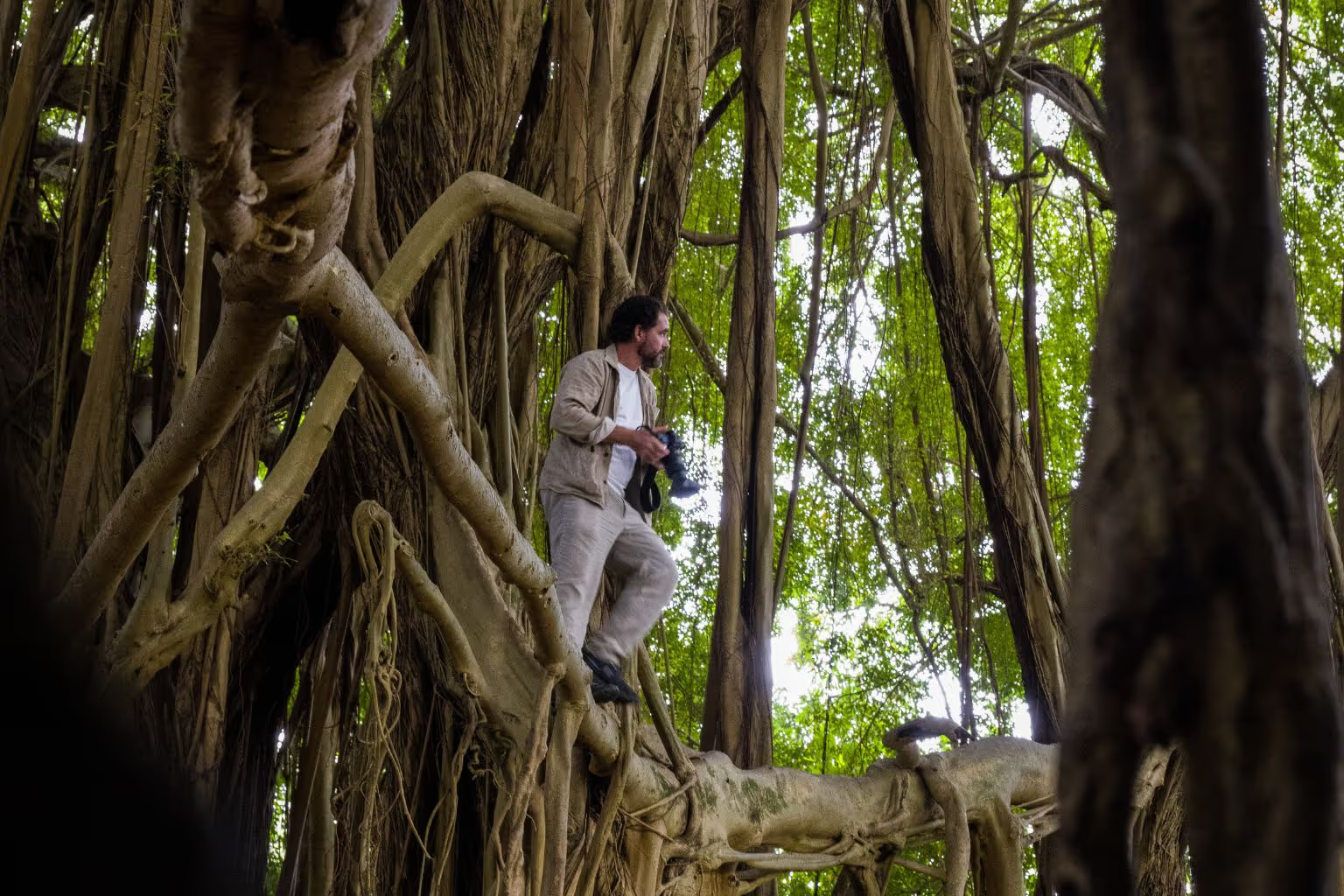
Perhaps unsurprisingly, what makes the book – and its serious climate messaging – so special is the storytelling, with Levison’s own experiences woven throughout. In it, he recalls visiting Finland’s frozen wilderness where his Sami trekking guide can “read the landscape like a map” and understanding nature’s signals is a way of ensuring survival in the harsh conditions. He remembers travelling to war-torn Ukraine to document the devastating environmental impact of the Russian invasion, meeting the director of 12,000-hectare Kamianska Sich National Nature Park, once home to over 90 species of rare animals. Now it is contaminated with explosive munitions. And, he recollects a trip accompanying rangers in the Virunga National Park where he saw swathes of forest that had been cleared on the borders between Rwanda and Uganda.
Yet for all the instances where our human relationship with nature appears to be forgotten, the takeaway is hopeful, as demonstrated through examples of organisations and individuals making a real difference (including Julia Butterfly Hill who inspired a new wave of activism after living in a 1,000-year-old Californian redwood for two years to stop the forest being destroyed for logging). “The heart of the book is about remembering that we are, and always have been, connected to nature in its broader form. What I’m trying to do is just encourage people to think more about how we relate to that by loving trees,” concludes Levison, who has plans to reach an even wider audience by turning The Great Tree Story into a film.
"As Benki Piyãko once said: 'We are the trees, and they are us. We are not apart from them. We are nature.'”

Levison’s book, The Great Tree Story, which explores the profound influence forests have had on our planet and civilisation was launched last month. He will also be sharing his adventures live on stage this month, across the UK in Walking The World, his upcoming national theatre tour.
levisonwood.com/books | levisonwood.com/speaking
Levison Wood
EXPLORER, ENVIROMENTALIST, ACCLAIMED WRITER