
Website Disclaimer October 2024

Important Legal Information & Terms of Use

By using the Cape Capital website (“Website”), you declare that:

  • You are a qualified investor according to Art. 10 para.3 of the Swiss Collective Investment Scheme Act (CISA) and/or a professional or institutional investor according to Art. 4 of the Financial Services Act (FinSA).
  • You are domiciled in Switzerland
  • You have understood and agree to the following Important Legal Information and Terms of Use (together “Conditions”)

By clicking “Accept all” you acknowledge and accept the following Important Legal Information and Terms of Use:

‍

‍

About this Website

‍

Cape Capital is an independent wealth manager headquartered in Zurich, Switzerland.

The content of this Website (including microsites) has been prepared by Cape Capital AG, with its registered address at Utoquai 55, 8008 Zurich, Switzerland (“Cape Capital”), duly registered at the commercial register of the Canton of Zurich with number CHE-109.617.147. and contains the views and opinions of the particular individuals and is for general information and marketing purposes only. All copyrights and other rights, included but not limited to logos and registered trademarks relating to the entire content of the Website are reserved exclusively to Cape Capital or the specifically designated right holders. Any use, in particular the reproduction or publication in full or in part is permitted only with the prior written consent of Cape Capital. Cape Capital may from time to time suspend the operation of this Website for repair, maintenance or improvement work, or in order to update or upgrade its content or functionality. Cape Capital may also change the format, content and/or access of this Website at any time at its sole discretion without notice. Although Cape Capital believes that information provided on this Website is based on reliable sources, content on this Website is presented only as of the date published or indicated, and may be superseded by subsequent market events or for other reasons. Therefore Cape Capital cannot assume responsibility for the quality, correctness, timeliness or completeness of the information contained herein. Unless otherwise stated, the numbers/figures on the Website are unaudited.

‍

Regulatory Status & Ombudsman

‍

Cape Capital is a regulated asset manager of collective assets according to the Federal Act on Financial Institutions of 15 June 2018 (FinIA) and supervised by the Swiss Financial Market Supervisory Authority FINMA, Laupenstrasse 27, CH-3003 Bern, Switzerland (FINMA). The Website contains information about various collective investments (“Funds”) which may have been registered or otherwise notified for distribution and marketing in the jurisdiction you have selected. Please note, that such registration or notification does not mean that the Funds are suitable for all investors and their investment objectives, financial situation and risk profile. As an asset manager of collective assets, Cape Capital is, among others, subject to the rules under the Swiss Financial Services Act (FinSA), the Swiss Collective Investment Schemes Act (CISA) and the Swiss Financial Institutions Act (FinIA).Cape Capital is affiliated to the following Ombudsman according to FinSA: Finanzombudsstelle Schweiz (FINOS), Talstrasse 20, CH-8001 Zurich, Switzerland. For further information, please refer to the General Client Information Document available on the Website which forms an integral part of these Conditions. Cape Capital is an independent wealth manager headquartered in Zurich, Switzerland.

‍

No Solicitation, Offer, Recommendation or Advice

‍

Nothing contained on this Website constitutes a solicitation, an offer or a recommendation to buy or sell any Cape Capital Funds or other financial instruments, nor does it constitute any form of personal investment advice which takes into account your personal circumstances. Cape Capital does not provide investment, legal, tax or other advice through this Website and nothing herein should be construed as such advice. Cape Capital does not represent that any Cape Capital collective assets or financial instruments mentioned on this Cape Capital website are suitable for any investor. Investment or other decisions should be made solely on the basis of the relevant product and/or service documents (prospectus/offering memorandum, fund contract/articles, key information documents, financial reports) of the respective collective investment. If not a Cape Capital client, it is strongly recommended to contact a professional financial advisor, tax consultant or other qualified expert in order to determine whether an investment in a Fund or other financial instrument corresponds to the specific requirements and preferred level of risk of the investor.

‍

US Persons

‍

Any collective investment schemes mentioned on this Website may, unless explicitly stated otherwise, not be offered, sold or delivered to United States (U.S.) citizens or persons resident or incorporated in the U.S. and/or other natural or legal persons whose income and/or returns, regardless of origin, are subject to U.S. income tax, as well as persons who are considered to be U.S. persons pursuant to Regulation S of the U.S. Securities Act of 1933 and/or the U.S. Commodity Exchange Act, in each case as amended from time to time.

‍

Risk Considerations

‍

The provision of financial services and investments in Funds and other financial instruments involve opportunities but also bear risks, including the risk that the value of investments and the income therefrom may fall or rise and investors may not get back the full amount invested or may even lose all of their investment. Investors should ensure to have fully understood such risks before taking any investment decisions. Cape Capital strongly advises to consult the brochure “Risks Involved in Trading Financial Instruments” of the Swiss Bankers Association (SBA) as well as  the relevant documents of the respective Fund or financial instrument and to seek professional investment advice before taking any decision to invest. Investors should note, that these Conditions do not represent a complete statement of risks associated to a Fund or a financial instrument. Past performance is no indication of current or future performance. Performance data do not include commissions and costs incurred by investors when subscribing or redeeming Fund shares.Investments, in particular collective investments in private equity, venture capital and other illiquid assets involve an above-average degree of risk, including the risk that losses may even exceed the original investment and should be seen as long-term in nature.

‍

No Warranties

‍

The use of this Website, including any information accessed, downloaded or otherwise obtained through the Website is at your own risk. This Website, together with all content, information and materials contained therein, is provided “as is” and “as available”, without any representations or warranties of any kind, whether express or implied, with respect to the Website, and all information and functionalities contained therein.

‍
Limitations of Liability

‍

IN NO EVENT SHALL CAPE CAPITAL BE LIABLE FOR ANY DIRECT, INDIRECT, INCIDENTAL, SPECIAL, PUNITIVE, CONSEQUENTIAL OR OTHER DAMAGES (INCLUDING WITHOUT LIMITATION DAMAGES FOR LOSS OF DATA, BUSINESS OR PROFITS) ARISING OUT OF OR IN CONNECTION WITH THESE CONDITIONS, THIS WEBSITE, THE INABILITY TO USE THIS WEBSITE OR ANY INFORMATION OBTAINED OR STORED THERFROM. Cape Capital excludes any liability for any loss, damage or alteration of any kind including but not limited to transmission to losses, delays, misunderstandings, unauthorized interception by third parties, duplication or fraud, except in the event of gross negligence on the part of Cape Capital. Any transmission or download of information is entirely at your own risk.

‍
Use of Links

‍

The hyperlinks on the Website are only provided for information and convenience purposes. Cape Capital is not responsible for the content of external websites that link or are accessible from this Website. Cape Capital does not assume any responsibility or liability with respect to any website accessed via this Website. Please note that when you click on any external website’s hypertext link you will leave this Website. You should review the privacy statements of such websites carefully before you provide any personal or confidential information.

‍

Electronic Communication Channels

‍

The use of electronic communication channels, in particular unencrypted e-mails and text messages, is associated with various risks which may include, but are not limited to, the risk of transmission errors, alterations or duplications, the risk of interception or manipulation of content and the risk of introducing malicious software (malware) by unauthorized third parties. By using such electronic communication channels, you accept these risks and agree to bear any resulting losses or damages.

‍

Data Protection and Privacy Settings

‍

Cape Capital has established a Cape Capital Privacy Notice, which forms an integral part of these Conditions. It explains how personal data is collected and processed at Cape Capital, including this Website. Cape Capital uses cookies to personalize and improve site experience. You can at any time change or withdraw your consent from the Cookie Declaration on the Website. Your consent applies to the following domains: capecapital.com. Your current state: Consent accepted or Consent rejected. Manage your consent.

‍
Applicable Law and Jurisdiction

‍

The access and use of this Website, and these present Conditions are governed by substantive Swiss law with the exclusion of the conflict of law principles. The place of jurisdiction is Zurich, Switzerland.

Last Update: October 2024

Your preference will be securely stored for the next 30 days.

DeclineAccept All

To access the website, the terms and conditions need to be accepted.

View terms
Preferences

This Cookie Policy explains what cookies are and how we use them, the types of cookies we use i.e, the information we collect using cookies and how that information is used, and how to control the cookie preferences. For further information on how we use, store, and keep your personal data secure, see our Privacy Policy. You can at any time change or withdraw your consent from the Cookie Declaration on our websiteLearn more about who we are, how you can contact us, and how we process personal data in our Privacy Policy.Your consent applies to the following domains: capecapital.com

Accept all cookies
Thank you! Your submission has been received!
Oops! Something went wrong while submitting the form.

What are waves? A child's simple question with a surprisingly complicated answer

‍

FOLIO Edition IX: WAVES
Lifestyle & Opinion

William Raynar, regular contributor to FOLIO, takes a deep-dive into the sea – from what causes swells to the benefits of avoiding overcrowded breaks

This summer, the French Atlantic coast seemed unusually full of Americans. Online holiday rental platforms have made the process almost frictionless: the booking is standardised, the calendar is open, and a week in France can be arranged in between meetings. Biarritz is far cheaper than the Hamptons even after taking a business class flight into account.

‍

One of those visitors was my friend Paul. He had rented Sorro-Gaina, an old, well-known house on the coastline between Bidart and Guéthary. From its terrace, one looks directly towards Parlementia, the long Basque reef break that forms offshore and, on the right day, peels towards the coast. The place has watched the first generations of French surfers (Les Tontons Surfeurs) do the same.

‍

I was there for lunch with Paul, his wife and their young daughter Athena. The swell was visible beyond the table. Athena watched the lines gather and asked her father: “What are waves? Where do they come from?” It was the kind of question that makes adults unexpectedly happy. Not because it is difficult to answer, but because it asks us to look again at something we had stopped seeing.

‍

Paul looked at the water for a moment. In a younger life, he had studied fluid dynamics. “A wave,” he said, “is not quite what it looks like.” It seemed to Athena that the water was coming towards them from the horizon. “Mostly, it isn’t,” he said. “Do you know the Ola, when people in a stadium stand up and sit down, one after another?” She nodded positively. 

‍

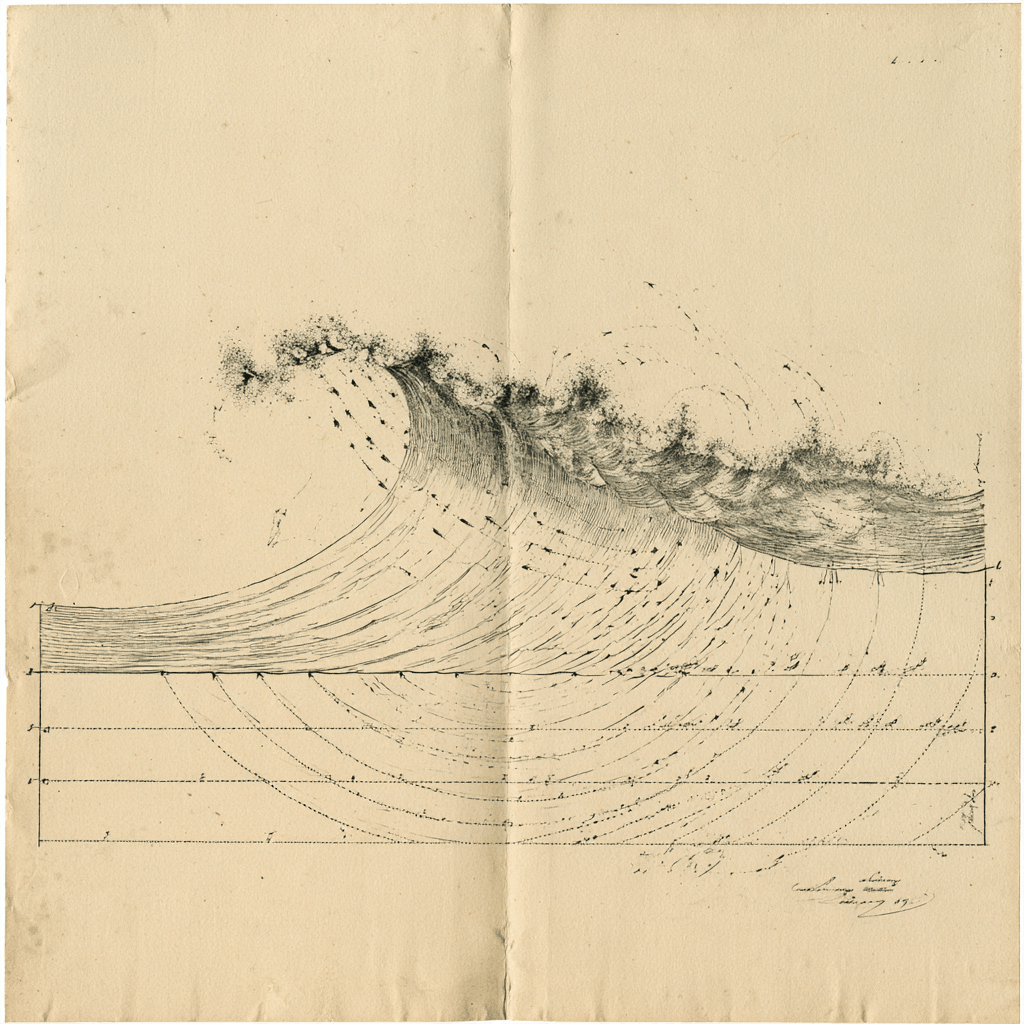
“The movement travels around the stadium, but the people mostly stay where they are. The sea does something similar. Water rises, moves forward a little, falls, and slips back. What travels is the energy, passed from one small movement to the next.” 

‍

“So, the water stays still?” she asked. “Not still,” Paul said. “It dances.”

‍

‍

So, what exactly is a wave?

Wind begins the dance. A breeze creates ripples; a storm blowing long enough across open water makes a swell. Then the storm can pass. The sky can turn blue. But its work travels on, sometimes for days.

‍

The sea remembers weather after the sky has forgotten it.

‍

During their journey, waves meet. Some arrive together and become larger. Others meet out of step and lose their force. And what lies beneath matters as much as what happens above. Far offshore, at Cortes Bank, off California, waves can break with no land in sight because a submerged mountain rises beneath them.

‍

Then there is Bremgarten, on the Reuss. Here the logic appears to reverse. In the ocean, the wave travels while most of the water merely doesn’t. On the river, the water charges downstream with all the force of the current, yet the wave stays in one place. A surfer can stand on it for minutes, neither advancing nor retreating, held above a movement that never stops. It is not the absence of energy that holds the wave there. It is energy meeting a boundary, again and again, in precisely the same place. The river does not pause. The wave does.

‍

We tend to regard that white crest as the wave’s finest moment, the instant when it becomes fully itself. Physically, it is the opposite. It is the point at which the wave has become unstable. Its apparent triumph is also its collapse. Then the water runs up the sand, pauses, and returns. Another wave is already forming far away. 

‍

Over the course of a few minutes, the shore seems fixed and the waves seem restless. Over centuries, the relationship reverses. Waves shift beaches, wear down cliffs and redraw coastlines. The land looks permanent only because our lives are short. As Paul said the words, “Our lives are short,” he realised it was no longer an answer designed for his daughter. Thankfully, she seemed to have lost interest and moved on to something else.
‍

‍

What surfers know about timing

While Paul spoke, surfers below had begun to paddle towards Parlementia. Some went too early and spent their strength before the set had arrived. Others waited too long and found the wave breaking over them. A few had read it better: they were in the right place when effort and energy met. This is the kind of positioning that Swedish surfer Maria Allebring, who took up the sport aged 39 and is now hoping to represent her country at the ISA World Surfing Games later this year, knows all about (read her FOLIO interview here).

‍

It occurred to me that markets reward something similar. Not clairvoyance, and certainly not constant motion, but position, patience and the ability to distinguish a passing ripple from a swell worth taking. Some investors exhaust themselves paddling for movements that never form. Others enter only when the wave has become obvious, and discover that the enjoyment will be short lived. The difficult work is to be ready without feeling obliged to stand up on every wave.

‍

As I was watching the surfers down below, I witnessed the quiet surfer’ law in action: the one closest to the point where the wave begins to break has priority. It is not awarded to the strongest swimmer, the largest board, or the loudest voice. Everyone else pulls back. When too many people try to take the same wave, nobody has room to ride it well.

‍

Markets have their own crowded breaks. The best ideas are often easy to recognise once enough people are waiting for them. That is when the wave can still look magnificent, but the space to move has narrowed and every turn matters more. The experienced surfer does not assume that the busiest peak offers the best ride. Sometimes he waits. Sometimes he paddles a little farther down the coast, towards a less fashionable break, where the waves are smaller perhaps, but the line is open.

‍

That is why surfers still travel to places such as Liberia: not because every wave is better, but because a clean line without a crowd can be worth more than a famous break with twenty people competing for the same take-off. The wave is real; it can lift you or knock you over. But it is not to be mistaken with the sea.

‍

In this article
Written by