


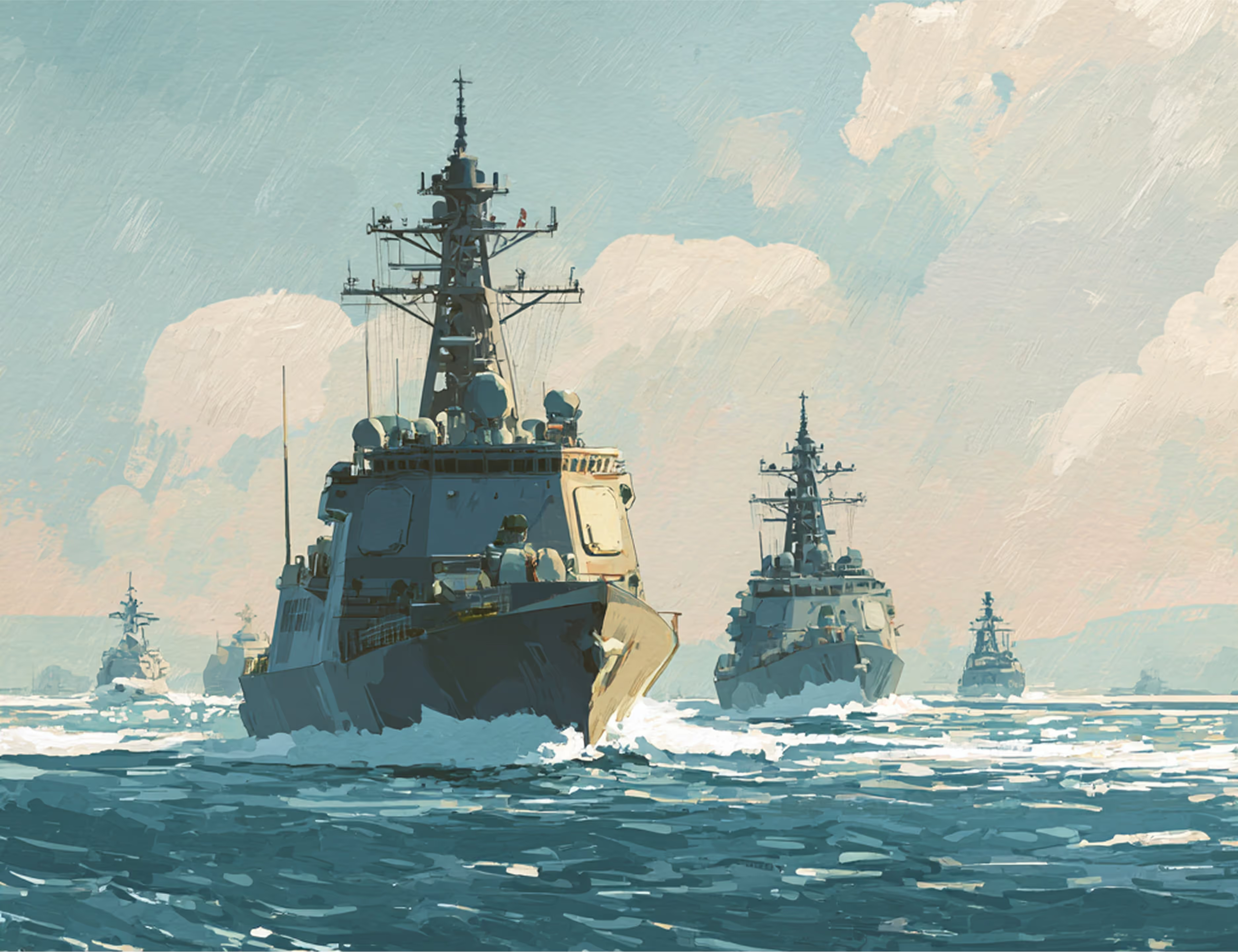
From crisis management to communication: why analysis of geopolitical scenarios is becoming an increasingly invaluable big-picture strategic tool
Considering the current global instability, it’s no surprise that the last few years have seen a resurgence in wargaming. “There has been a growing interest in wargaming, particularly in the US and UK, since around 2014 when Russia annexed Crimea,” confirms Finley Grimble, an expert on the subject who spent over a decade in strategic advisory, wargaming, policymaking and diplomatic roles for the UK Government. “We often think of wargaming in modern times as being from the 19th-century Prussians whose army used the technique in military training but Alexander the Great was wargaming during the invasion of Persia 2000 years before.”
Increasingly, it’s not just governments who consider wargaming a useful forward-planning tool but all kinds of industries from energy and technology to finance – which is where London-based Knightsbridge Strategic Group (KSG), the company Finley set up in 2023, comes in. “Wargaming is the thing that we’re known for and it takes up roughly half our time,” he says, citing intelligence, strategic development and providing AI solutions as some of the other elements of his business.

Crucially though, these exercises – which are based on real intelligence and typically involve several plausible scenarios that could happen in, say, the next six months – go beyond hypothetical thinking to stress-test assumptions, identify vulnerabilities and rehearse strategic responses to geopolitical shocks. “Wargames have a tangible effect. They allow finance companies, for instance, to model how a sudden de-risking event influences asset classes and how markets would react to secondary sanctions,” he explains.
So players must live with the consequences of their decisions as the situation develops. That way they can see missing gaps and what they should have thought about.
“Our wargames force companies to test different conflict trajectories and think about what their real-world actions would be in a crisis before it occurs: perhaps moving money around, liquidising assets or reconsidering investment plans based on anything from sea lines of communication that might be affected by an invasion to the possible rising price of gold,” he continues. A crucial second turn follows “so players must live with the consequences of their decisions as the situation develops. That way they can see missing gaps and what they should have thought about.”
One of the most requested scenarios KSG has created wargames for lately is a possible China-Taiwan conflict, that would drag in the US. “My assessment of such a scenario’s effects are less calamitous than most peoples but it’s generally believed that a great power conflict between the US and China in the region would lead to an unparalleled meltdown, including the shutdown of a huge proportion of global trade. People around the world would fall into poverty. Oil prices would surge astronomically. Above all, it’s feared that a devastating long-term war would be unavoidable,” continues Finley, adding that the media exacerbates these concerns.
“If I provide you with a more tempered assessment – that a conflict over Taiwan could be contained to the region and won’t be an overwhelmingly catastrophic event which halts all semiconductor supply chains – it doesn’t sell newspapers. KSG’s goal is to provide rational, objective assessments and then propose implications that go beyond the headline risk. Organisations come to us because they want the reality.” Finley stresses that wargames (which he follows up with a debrief in the form of an insights report) are not about trying to predict the future but instead help companies cover all angles and become more prepared by developing mitigation strategies and increase resilience ahead of time.
Wargames are a great opportunity for cross pollination, to enable directors or CEOs to bring all the pieces of the jigsaw together and understand the broader overview
A lesser-known application of wargaming includes improving communication with clients in potentially unprecedented circumstances – and taking time to properly drill down into the details of what the message needs to be. “When a business relies on client relations, we can create dedicated moments in the game to refine wording so that if there is a geopolitical crisis, a reassuring, well thought-out response to clients is already drafted, perhaps saving crucial hours,” he says. “Another key use is that organisations, whether large or small, can often be quite disparate, with people siloed and focused on a particular region or aspect of the operation. Wargames are a great opportunity for cross pollination, to enable directors or CEOs to bring all the pieces of the jigsaw together and understand the broader overview.”
Looking at the bigger picture is a skill that Finley has had plenty of practice at. A self-labelled history nerd who was fascinated by famous figures like Napoleon, Bismark, Machiavelli and Cardinal Richelieu while growing up, he chose International Relations and Security as his second MA degree (the first was in history). Alongside studying, he advised several MPs in England and Wales on foreign and defence policy matters before going on to work at the Ministry of Defence, Cabinet Office and Foreign Office as a grand strategist. “My role involved seeking to bring together all the levers of state, from military, diplomatic, intelligence and economics, to soft power and culture, all to achieve a wider objective for the UK and its allies.”
.avif)
Fast forward to now and through KSG, he is also currently embedded at NATO, providing wargaming, strategy and AI services. Ultimately, says Finley, wargames are simple at their core. “All we’re doing is immersing ourselves in a situation, preparing multiple pathways, assessing options and taking actions to put contingencies in place.” Something which he believes is far more effective than sitting in a three-hour unstructured discussion-style meeting. “Applying that to a financial institution, wargaming exercises allow boards and risk teams to refine trigger points, to think about what early indicators will drive reallocation, capital calls or market exits in a crisis,” he concludes. “Really, it’s just about asking: what are the issues we are potentially going to face and what are the solutions?”
Want to know more about Finley? Visit his website here
Finley Grimble
CEO, Knightsbridge Strategic group
Cape Capital