


.avif)
Consultant, trainer and Cape Conversation participant Dr Nikolas Epp talks brain training, biology and why multitasking isn’t always a good thing
Recognizing hidden stress in the workplace
Have you ever lost focus in a meeting because your mind is already racing ahead to the next one? Or typed an email to a colleague while on a call with your manager? According to Dr Nikolas Epp, this type of multitasking is a typical display of unconscious workplace stress. "As humans, we can induce our biological stress response by thought alone: we don’t need a life-threatening situation such as a predator or a natural disaster," he explains. "These thoughts become repetitive and we get very good at creating them. Habituated or unconscious stress is characterised by us not noticing when we are in that state."
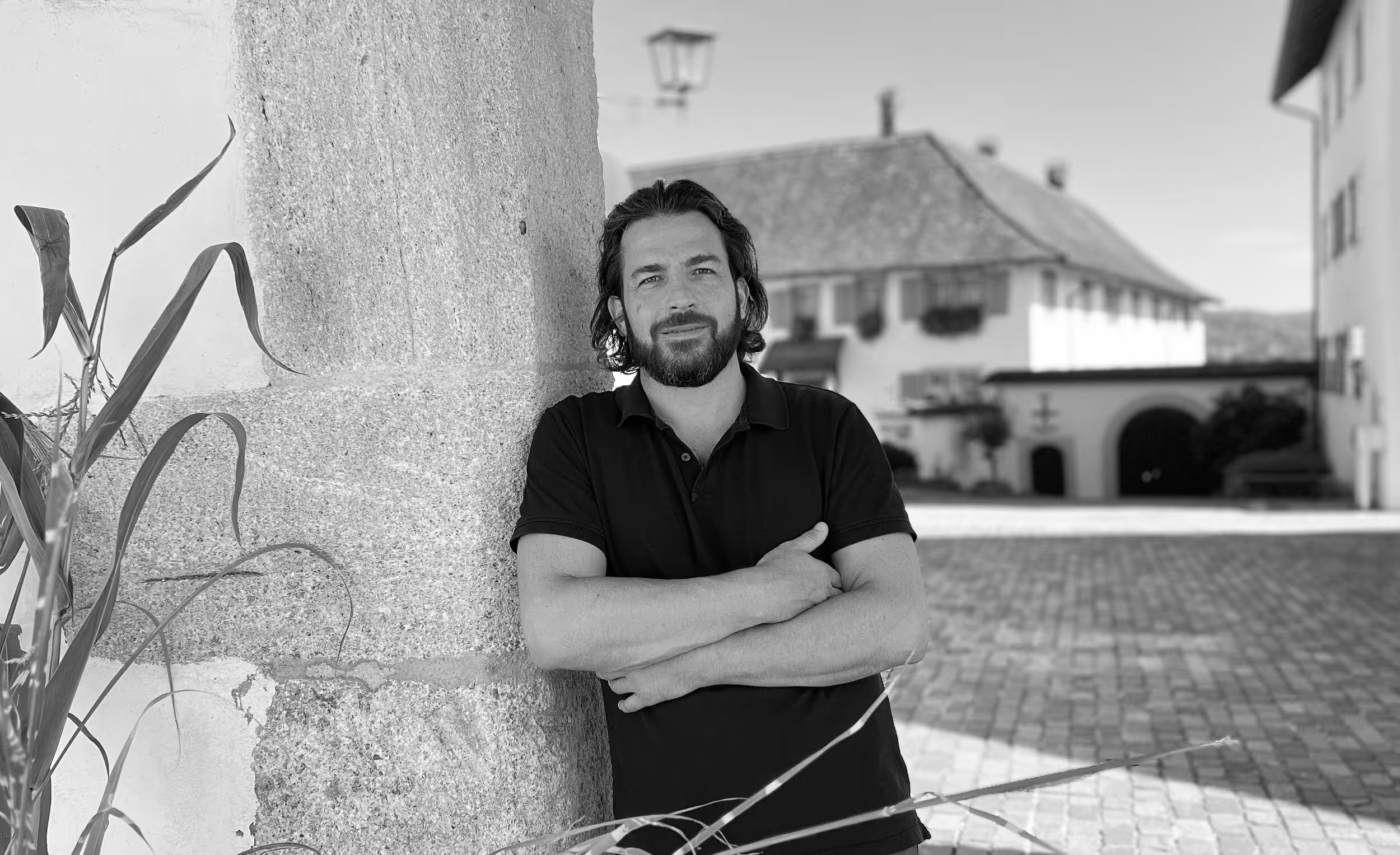
On a wider level, employees in survival mode affect organisations in a multitude of negative ways – an area Nikolas delved deeper into for a research paper he wrote in collaboration with the St Gallen Business School, published last year. "The main finding was that all issues within businesses are fuelled to some extent by unconscious stress. This manifests itself in various symptoms, from burnout rates to work dissatisfaction and a lack of communication,’ he reveals. ‘An organisation is the sum of the group of people working there and when an individual is in a state of unconscious stress, it impacts health and behaviour collectively."
When survival mode takes over
Changes in behaviour can include someone becoming less creative, more controlling - he says. "When an individual has a narrow focus on a perceived threat, they try to control and predict everything. They don’t open up or share ideas; they’re not good at finding solutions. That’s usually called micro-management. Or they begin to complain and suffer more. That affects the entire workforce." He believes the biggest mistake businesses often make is to try and find solutions to a problem while their employees are in a negative state of mind. "That's what most businesses force employees to do. They say: we have this tough competitor, our numbers are decreasing, let's have a brainstorm meeting now, because otherwise we’ll lose our jobs. You don't get much creativity out of people in that mindset."
Nikolas began his own career by studying chemistry with a focus on quantum mechanics before doing a PHD in cell biology (the former teachings on energy now feed into his one-to-one counselling sessions; the latter gave him an in-depth understanding of the science behind how the body works). After 15 years working in management positions in the chemical and pharmaceutical industries, he switched to what he does today: helping companies and individuals treat, not just the surface-level symptoms of unconscious stress, but the root cause. ‘When you really want to change things, you need to teach people how to alter their biology of flow, those biological principles that apply when an organism is in survival mode,’ he explains.
Building resilience from within
The first step, of course, is knowledge. "There needs to be an awareness about what unconscious stress really is – that is, being in a non-positive emotional state and not fully in the present. When people understand it from an intellectual perspective, they realise that they don’t want to continually live in survival mode," he continues. "Many organisations spend a lot of money to overcome symptoms of stress but find that it doesn’t work because they are bringing in something from outside. Change has to come from within."
.avif)
His solution sounds deceptively simple: "The easiest tool to use when you become aware of your brain jumping around in a negative way, is to stop those thoughts. Literally, just stop them." The difficulty though, lies in the fact that stress is habit-forming. "Cortisol is highly addictive and your brain gets used to this rush of energy. When you start relaxing, usually, your body goes on the rampage and tries to find something to worry about or a reason to be hard on yourself, just to allow your emotional brain to produce those chemicals again," says Nikolas. "The initial stopping is easy, it’s the continuing to stop which is the hard part because the body doesn’t know what it feels like to be in a calm, natural state."
Mindset, breathwork, and daily practice
To counteract this, he encourages individuals in the workplace to re-evaluate how they might respond to certain scenarios. For instance, if someone has spent weeks preparing for a presentation which is cancelled at the last minute, rather than feeling frustrated about the time and effort wasted, instead he advises honing in on the positive take-aways and what’s been learnt throughout the process. "It’s all about mindset, rewiring the programme in your brain to practise different thoughts,’ says Nikolas, who suggests writing down thoughts, actions and how someone wants to feel as a tool to help alter their reactions. ‘I often find that successful, high-performers want change to happen all at once but really, for this approach to be sustainable, small steps need to be taken."
.avif)
He also advocates breathwork. "It’s not about specific breathing techniques such as Kundalini or Wim Hof. In my lectures, I talk about putting the attention on the breath as a way of focusing people’s thoughts on the now," says Nikolas. *When we catch ourselves not being in the present, putting the attention on your breath is a very good idea. The nervous system calms down and this is when we become creative again." On a fundamental level, for a company to thrive it must have a high interest in having healthy employees. "If you want an atmosphere of creation and collaboration, you need people who have an understanding about their biology and how to bring themselves out of the state of survival that they are so well conditioned to be in," Nikolas concludes.
Dr. Nikolas Epp
Consultant, trainer and expert on unconscious stress.