


Former British intelligence operative Julian Fisher believes that everyone has the skills to act like a spy – and make life-changing human connections in the process.
From persuading a police officer to magic an opposition supporting journalist out of an African country when his life was in danger, to ascertaining whether a company involved in the Republic of Guinea’s diamond industry had taken a bribe by befriending a translator, Julian Fisher is a master in targeting what he describes as ‘goals allies’: people who are not only able but willing to help. Which is exactly what you’d expect from a former British intelligence operative who spent nearly a decade working with and for government agencies in the field of international relations.
“I didn’t go into government work with any particularly formed expectation. My interest was strictly diplomacy and I ended up doing a variant of that,” he reveals. “The first time it was explained to me what an intelligence officer does, I was blown away. I couldn’t get my head around how anyone is capable of travelling to a hostile country with the purpose of cultivating and recruiting traitors, who then use their access to share classified information in support of another nation’s interests.”
Cover can come in many forms but it needs to be tailored to the personality and interests of the target while also remaining true to the user.

One important aspect of this, of course, is cover, which Julian divides into two types: defensive (to protect against detection) and offensive (how someone presents themselves to a potential target). “It feels like cover involves duplicity and manipulation but nothing could be further from the truth. In fact, what it involves is the establishment of a relationship of trust which is quite beyond anything I’ve seen in any other walk of life,” he says. “Cover can come in many forms but it needs to be tailored to the personality and interests of the target while also remaining true to the user. If an intelligence officer is cultivating a target undercover, at some point when they go to recruit, they have to divest themselves of that cover so it must be authentic because the relationship has to transcend the deceit involved.”
Although outwardly, this all seems a far cry from Julian’s first career as a stockbroker in the City of London, he believes that there are some similarities. “At the time, my job in finance was all about building relationships with clients and sources overseas who were able to give pointers on what was happening within the political and business environment. What I found frustrating was using that information for something I wasn’t passionate about. I wanted to use it, broadly speaking, to improve Britain’s place in the world.” Applying to join the Foreign Office seemed like a logical next step and one that also fitted with his long-held desire to work in Africa. “I first tried to visit during my gap year, volunteering for a charity, but the expectation was that I had to raise a lot of money to get there which I wasn’t in a position to do. Later, I holidayed in Zimbabwe and still remember the smell and warmth when I got off the plane. I felt like I’d come home.”
Since swapping government work for the private intelligence world in the mid-2000s, countries such as Somalia and South Sudan have remained Julian’s focus. Most recently that has involved “supporting companies who invest in Africa to be good corporate citizens. Using intelligence to help them understand whether their relationships with entities on the ground exposes them to the risk of corruption is an important part of that.” He has also been diversifying, stepping back from operational work to write his first book, Think Like A Spy: Master the Art of Influence and Build Life-Changing Alliances. Part memoir and self-help, part business manual, it was published last year and is the subject of a recent Cape Conversation.
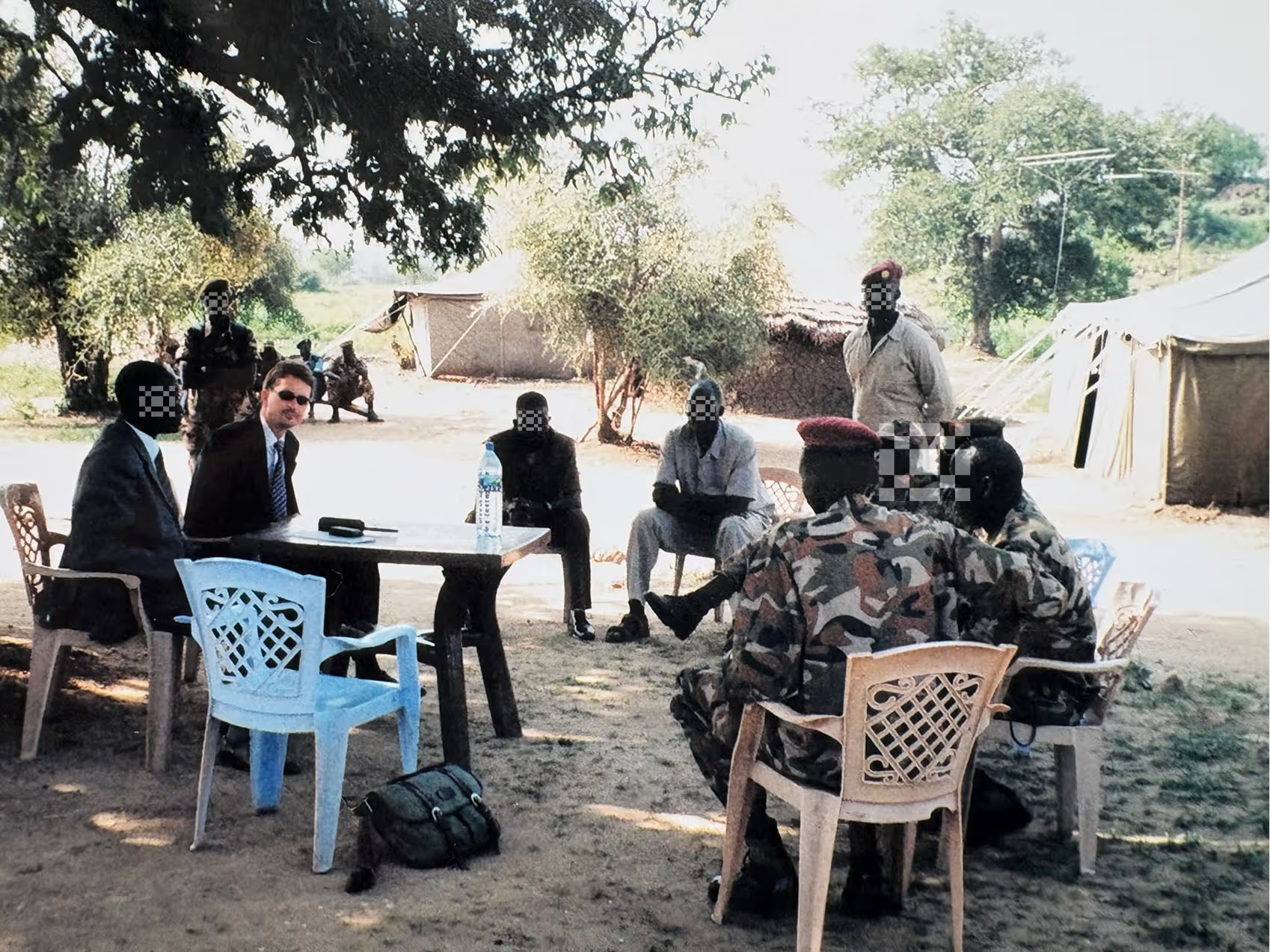
“The idea for the book has been in my mind for around a decade,” he says of its underlying premise, which is that you don’t have to be working for an intelligence service to do intelligence work. “There’s a misleading belief that intelligence officers have access to a kitbag of interpersonal skills not available to anyone else and I am convinced that’s wrong. Those skills are present in all of us; they are just used by spies in a way that is intentional. We all have the ability to target goals allies, to adopt cover – by which I mean present the best version of ourselves to develop relationships – and elicit information on both professional and social terms.”
The best use of cover doesn’t prey on vulnerability, it offers strength, support and empathy.
All of us, he says, use at least three covers a day or present different versions of ourselves depending on the situation: perhaps one in public, another at work and a third with loved ones. “In the civilian world, I’m absolutely not talking about being false or deceitful. The best use of cover doesn’t prey on vulnerability, it offers strength, support and empathy, which is only possible if you can tune into that part of your character that’s capable of experiencing the same as the person you’re talking to. It sounds ludicrously paradoxical but it is about authenticity.”

Another idea explored in the book is social capital. He relays how his first introduction to the concept (although he didn’t consciously realise it at the time) was a trainee nurse he met while in hospital as a teenager, who shared the story of her family’s flight from Iran’s revolution in 1979. Helping a university student to practise Farsi ultimately resulted in her English improving and gaining the financial support she needed to sit her nursing exams. “Her story taught me the importance of allies and I was determined to find them to help propel me into a different life,” he recalls.
Today, Julian is passionate about social mobility and hopes to “inspire readers to realise that they have within themselves a set of capabilities and skills which they can improve and perfect to make a profound change to their progress.” His mantra is that it’s not only about what you know but who you know, and everyone can control both those things. “It’s important to be able to build your own network of social capital – those who offer support, advice, introductions and help grow self-confidence – particularly for those who come from financially disadvantaged backgrounds. Also, young people face the double impact of social media and AI on their professional lives and so more than ever, it’s necessary that they form alliances and understand the importance of interpersonal relationships.” Whether a spy or a civilian then, it seems that true human connection trumps all.
Julian Fisher recently held a Cape Conversation with Cape's Michael Knuchel.
Want to know more about Julian? Visit his website here
Julian Fisher
Former spy
Cape Capital